What is Agentic AI? A Beginner's Complete Guide (2026)

Picture this: you ask your AI assistant to plan a product launch — not just write you a checklist, but actually research competitors, draft the email campaign, schedule the kickoff meeting, coordinate with your team’s calendar, and flag budget risks. All on its own. No back-and-forth. No hand-holding.
That’s not science fiction. That’s Agentic AI — and it’s already changing how businesses operate in 2026.
If you’ve heard the term tossed around in tech meetings or spotted it in headlines but aren’t sure what it really means, you’re in the right place. This guide breaks it down — plainly, honestly, and with examples you can actually use.
$47B Agentic AI Market Size by 2030 | 78% Enterprises Piloting AI Agents in 2026 | 3.5× Productivity Gain vs. Traditional Automation |
|
What is Agentic AI? (Simple Definition)
Agentic AI refers to artificial intelligence systems that can independently set goals, plan multi-step tasks, take actions, and adapt based on results — all without needing a human to guide every single step.
Think of it this way: regular AI answers questions. Agentic AI gets things done. It doesn’t just respond — it acts, learns from what happened, and keeps going until the job is complete. |
The word ‘agentic’ comes from ‘agency’ — meaning the capacity to act independently. When AI has agency, it behaves less like a calculator and more like a capable colleague who takes initiative.
Agentic AI vs. Generative AI: What's the Difference?
Most people are familiar with Generative AI — tools like ChatGPT, Gemini, or Claude that produce text, images, or code based on prompts. But Agentic AI takes things a significant step further.
Feature | Generative AI | Agentic AI |
Responds to… | Single prompts | Multi-step goals |
Works… | One turn at a time | Autonomously over time |
Uses tools? | Rarely | Yes — web, code, APIs, files |
Makes decisions? | No | Yes — plans & adapts |
Needs human input? | Every step | Only at the start |
Best for… | Writing, Q&A, creative tasks | Complex workflows, automation |
How Does Agentic AI Actually Work?
Agentic AI systems are built on a core loop that repeats until a goal is completed. Here’s how that loop plays out in plain English:
- Perceive — The agent reads its inputs: your instructions, previous results, data from tools, or the state of the environment.
- Plan — It breaks the goal into smaller sub-tasks and decides what to do first, second, and third.
- Act — It executes: searching the web, writing code, calling APIs, sending an email, or updating a document.
- Observe — It checks what happened. Did it work? Was the output correct? What changed?
- Adjust — Based on what it learned, it refines the plan and loops back to step one — until the goal is done.
This loop is powered by a combination of large language models (for reasoning), tools (for taking actions), and memory (for maintaining context across steps). In advanced setups, multiple specialized agents collaborate — one agent searches the web, another writes code, a third reviews quality — all coordinated by an orchestrator agent.
Agentic AI in the Real World: 6 Practical Examples
The best way to understand Agentic AI is to see it in action. Here are six real-world scenarios where agentic systems are already delivering value
1. Sales & CRM Automation
An agentic AI monitors your CRM, identifies leads that haven’t been contacted in 14 days, drafts personalized outreach emails based on each lead’s industry and recent activity, schedules follow-ups, and updates the CRM — all overnight, while your team sleeps.
2. IT Operations & Incident Response
When a server alert fires at 2 AM, an AI agent diagnoses the issue, cross-references runbooks, applies a fix, tests whether it worked, and only pages a human engineer if the automated fix fails. Downtime drops. Engineer burnout drops too.
3. Software Development
Developers describe a feature in plain English. An agentic coding system writes the code, runs tests, identifies failing cases, rewrites the broken logic, and opens a pull request — all before the developer’s morning coffee.
4. Financial Research & Reporting
An AI agent pulls earnings reports, news articles, and market data across 30 companies, synthesizes insights, identifies anomalies, and generates a ready-to-present investment brief — a job that previously took analysts two full days.
5. Customer Support Escalation
An agentic support system handles tier-1 queries automatically, pulls customer history, processes refunds within policy limits, escalates edge cases with a full context summary, and learns from each resolved ticket to improve future responses.
6. HR & Recruitment Workflows
From posting job descriptions to screening resumes, scheduling interviews, sending rejection emails, and preparing onboarding documents — agentic AI can handle the entire recruitment pipeline, freeing HR teams for the human conversations that actually matter.
The 4 Core Components of an Agentic AI System
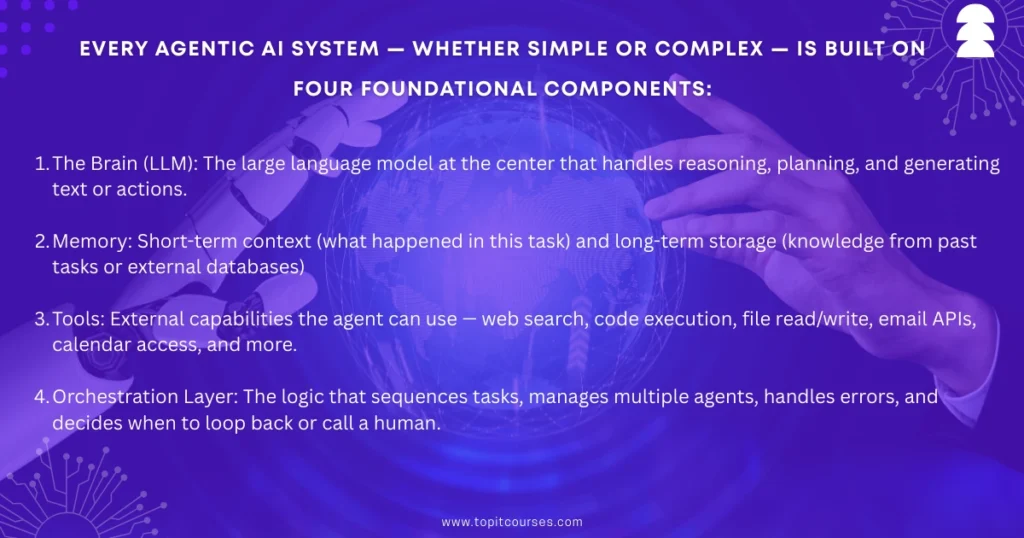
Every agentic AI system — whether simple or complex — is built on four foundational components:
Agentic AI in the Real World: 6 Practical Examples
The adoption numbers don’t lie — organizations across every sector are moving fast on agentic AI. Here’s why:
- Speed at scale: Tasks that take human teams days are completed in hours, without sacrificing quality.
- 24/7 operation: Agents don’t sleep, take vacations, or get overwhelmed during peak periods.
- Reduced error rates: Consistent execution of defined logic outperforms manual processes prone to human error.
- Cost efficiency: One orchestrated agentic system can replace the need for multiple specialized software tools.
- Continuous learning: Agents improve over time as they encounter more scenarios and edge cases.
Honest Limitations: What Agentic AI Still Gets Wrong
Fair warning: Agentic AI is powerful, but it’s not magic. Here’s what you should know before deploying it in your organization
- Hallucination risk: Agents can confidently take wrong actions based on incorrect reasoning. Human checkpoints matter.
- Cost of compute: Running multi-step agents across many tasks burns through API tokens quickly. Budget planning is essential.
- Unpredictable edge cases: Novel situations can send agents into loops or unexpected states. Robust error handling is non-negotiable.
- Security exposure: Agents with access to email, code repos, or databases must be tightly permission-controlled.
- Explainability gap: Tracing why an agent made a specific decision can be difficult — a concern in regulated industries.
How to Get Started with Agentic AI (For Beginners)
You don’t need a PhD in machine learning to start experimenting with agentic AI. Here’s a practical roadmap:
- Identify a repetitive, multi-step workflow in your work — something that follows a pattern but eats up hours.
- Explore no-code/low-code platforms: Tools like n8n, Zapier AI, Microsoft Copilot Studio, and Vertex AI Agent Builder let you build agents without writing code.
- Start small: Deploy a single-agent system for one task. Measure its accuracy and cost before scaling.
- Add tools gradually: Start with web search or document reading. Add email or CRM access only after you’ve validated accuracy.
- Build in human review: For high-stakes decisions, configure the agent to surface its output for human approval before taking action.
- Iterate: Review agent logs weekly. Identify where it stumbles and refine prompts or workflows accordingly.
Where to Start the Career?
Best IT Courses for Beginners
If you are new to the tech industry, you can explore beginner-friendly IT courses that can help you start your career.
You can Start from here:
https://sadiqtechsolutions.com/
Best IT Courses E-Books
If you are planning to start for IT Careers then we have a professional e-Books
Start Career with our Professional e-Books : https://topitcourses.com/
Download Free IT Resume Templates
If you are planning to apply for IT jobs, having a professional resume is very important.
You can download free resume templates from our website.
Download Free Resume:
https://www.topitcourses.com/free-resume-templates
Google AI Research
Google is one of the leading organizations researching artificial intelligence technologies.
https://ai.googleIBM Artificial Intelligence
IBM provides insights into artificial intelligence technologies and how they are used in businesses.
https://www.ibm.com/artificial-intelligenceOpenAI Research
OpenAI works on advanced AI technologies including large language models and autonomous AI systems.
https://openai.com/researchMIT Technology Review – AI
MIT Technology Review publishes insights about the latest innovations in artificial intelligence.
https://www.technologyreview.com/topic/artificial-intelligence
Frequently Asked Questions About Agentic AI
These are the questions real people are searching for answered directly.
❓ Is Agentic AI the same as Artificial General Intelligence (AGI)? |
No. Agentic AI is not AGI. AGI refers to a hypothetical system with human-level intelligence across all domains. Agentic AI is a specialized architecture that enables task-specific autonomy. It’s impressive and capable, but it operates within defined boundaries and does not possess general reasoning or consciousness. |
❓ What’s the difference between an AI agent and an AI assistant? |
An AI assistant (like a chatbot) responds when asked and completes one task at a time. An AI agent proactively takes sequences of actions toward a goal, uses external tools, and can operate without continuous human prompting. Assistants are reactive; agents are proactive. |
❓ Which industries benefit most from Agentic AI? |
Financial services, healthcare administration, software development, e-commerce, legal research, HR, and IT operations are seeing the strongest early gains. Any industry with high volumes of repetitive, structured workflows is a strong candidate. |
❓ Is Agentic AI safe to use in my business? |
It can be — with proper governance. Safety depends on how tightly you control permissions, how often you review outputs, and how well the system handles unexpected inputs. Organizations implementing agentic AI should establish clear policies for data access, audit trails, and escalation paths. |
❓ What are the best Agentic AI platforms in 2026? |
Leading platforms include OpenAI’s Assistants API, Google Vertex AI Agent Builder, Microsoft Copilot Studio, Anthropic’s Claude with tool use, AutoGen (Microsoft Research), LangGraph, CrewAI, and n8n for workflow automation. The right choice depends on your technical depth and use case. |
❓ Will Agentic AI replace human jobs? |
It will certainly change them. Repetitive, rule-based tasks are most at risk. But roles requiring judgment, empathy, creativity, and relationship management are evolving — with humans increasingly focused on supervising, configuring, and refining the agents that handle execution. |
Agentic AI isn’t a distant future concept. It’s a present-tense shift in how work gets done — and organizations that understand it early will hold a meaningful advantage over those that don’t.
At its core, the idea is simple: instead of AI that responds, we now have AI that acts. Instead of tools that wait for instructions, we have systems that pursue goals. That’s a fundamental change and whether you’re a business leader, developer, or curious beginner, getting familiar with it now is one of the smartest things you can do in 2026.