How to Use AI for Small Businesses to Increase Revenue in 2026
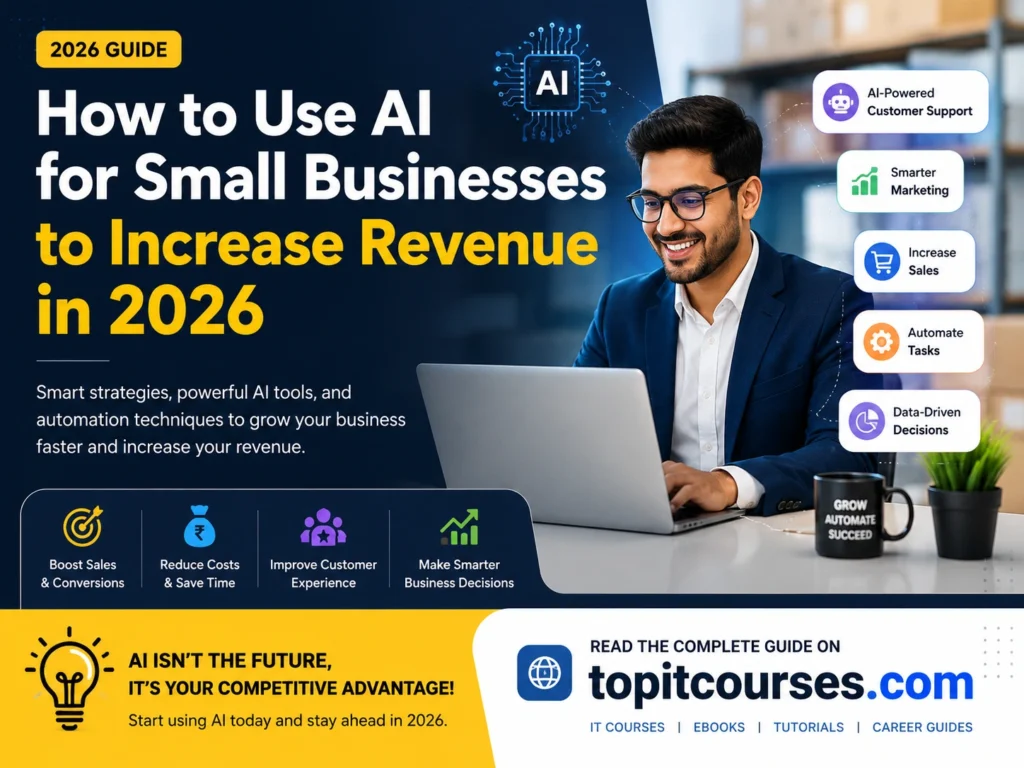
Artificial Intelligence (AI) is no longer limited to large enterprises with massive budgets. In 2026, affordable AI solutions have made it possible for startups, local shops, service providers, and online businesses to automate tasks, improve customer experiences, and generate more revenue.
Whether you own a retail store, coaching institute, digital marketing agency, restaurant, healthcare clinic, or eCommerce business, AI can help you work smarter rather than harder.
This guide explains how to use AI for small businesses to increase revenue in 2026, including practical strategies, the best AI tools, real-world use cases, and common mistakes to avoid.
Why AI Is Important for Small Businesses in 2026
Small businesses often struggle with limited budgets, fewer employees, and increasing competition. AI helps solve these challenges by automating repetitive tasks and providing data-driven insights.
Instead of hiring multiple employees for every business function, AI can handle customer support, content creation, marketing, lead generation, appointment scheduling, and data analysis.
Businesses that adopt AI early gain advantages such as:
- Increased productivity
- Lower operational costs
- Better customer satisfaction
- Faster decision-making
- Higher sales conversions
- Improved marketing performance
According to industry reports, AI adoption among small businesses continues to grow as more affordable and easy-to-use tools become available.
Benefits of AI for Small Businesses
1. Improve Customer Service
Customers expect quick responses. AI-powered chatbots can answer common questions, provide product recommendations, schedule appointments, and collect customer information 24/7.
Benefits include:
- Faster response times
- Reduced support costs
- Higher customer satisfaction
- More qualified leads
Popular tools include ChatGPT, Intercom AI, Tidio AI, and Zendesk AI.
2. Automate Marketing Campaigns
Marketing automation helps businesses save time while improving campaign performance.
AI can:
- Write email campaigns
- Generate social media posts
- Create blog articles
- Design marketing graphics
- Optimize advertisements
- Personalize customer messages
This allows business owners to focus on strategy rather than repetitive content creation.
3. Increase Sales with Personalized Recommendations
Online stores use AI to recommend products based on customer behavior.
Examples include:
- Frequently bought together
- Recently viewed products
- Personalized discounts
- Product recommendations
- Smart upselling
These recommendations encourage customers to purchase more items, increasing the average order value.
4. Reduce Operational Costs
AI reduces manual work by automating repetitive tasks such as:
- Invoice generation
- Data entry
- Inventory updates
- Employee scheduling
- Customer follow-ups
- Appointment reminders
Businesses save both time and money.
5. Make Better Business Decisions
AI analyzes business data faster than humans.
It can identify:
- Best-selling products
- Customer buying trends
- Peak sales hours
- Marketing ROI
- Inventory shortages
- Revenue forecasts
These insights help owners make informed decisions.
Best Ways to Use AI for Small Businesses
AI-Powered Customer Support
Instead of hiring a full-time support team, AI chatbots can answer customer questions around the clock.
Example:
A customer visits your website at midnight.
Instead of waiting until morning, the chatbot:
- Answers product questions
- Shares pricing
- Books appointments
- Collects contact details
This prevents lost sales opportunities.
AI Content Creation
Content marketing drives traffic and generates leads.
AI tools help create:
- Blog posts
- Product descriptions
- Social media captions
- Email newsletters
- Video scripts
- Marketing copies
Popular AI writing tools include ChatGPT, Jasper AI, and Copy.ai.
AI for Social Media Marketing
Managing multiple social media accounts takes time.
AI tools help by:
- Scheduling posts
- Generating captions
- Suggesting hashtags
- Creating images
- Writing video scripts
- Analyzing engagement
Businesses maintain a consistent online presence with less effort.
AI Email Marketing
AI personalizes email campaigns based on customer preferences.
Examples include:
- Welcome emails
- Cart abandonment emails
- Promotional campaigns
- Product recommendations
- Customer retention emails
Personalized emails often achieve better open and click-through rates.
AI Lead Generation
Finding quality leads is time-consuming.
AI can:
- Qualify leads
- Score prospects
- Analyze buying intent
- Recommend follow-ups
- Automate lead nurturing
Sales teams spend more time closing deals instead of searching for customers.
AI Sales Forecasting
AI analyzes previous sales data to predict future demand.
Benefits include:
- Better inventory planning
- Improved budgeting
- Smarter purchasing decisions
- Reduced stock shortages
Best AI Tools for Small Businesses in 2026
ChatGPT
Best for:
- Content writing
- Customer support
- Business planning
- Marketing ideas
- Research
Canva AI
Perfect for:
- Social media graphics
- Posters
- Presentations
- Advertisements
- Logos
Microsoft Copilot
Useful for:
- Excel analysis
- PowerPoint creation
- Word documents
- Outlook emails
Google Gemini
Helps with:
- Research
- Writing
- Productivity
- Business insights
Notion AI
Ideal for:
- Documentation
- Project management
- Meeting summaries
- Team collaboration
Zapier AI
Automates workflows between applications.
Examples:
- Gmail
- Slack
- CRM
- Google Sheets
- Shopify
HubSpot AI
Excellent for:
- CRM automation
- Sales pipelines
- Marketing campaigns
- Customer relationship management
AI Use Cases by Industry
Retail Stores
AI helps with:
- Inventory management
- Product recommendations
- Customer loyalty
- Sales forecasting
Educational Institutes
Training institutes can use AI for:
- Student inquiries
- Course recommendations
- Attendance tracking
- Marketing campaigns
- Content creation
Healthcare Clinics
AI supports:
- Appointment scheduling
- Patient reminders
- Medical documentation
- Customer communication
Restaurants
Restaurants use AI for:
- Online ordering
- Table reservations
- Menu recommendations
- Customer feedback analysis
Digital Marketing Agencies
AI improves:
- SEO research
- Content creation
- Advertisement copy
- Analytics
- Reporting
Step-by-Step Guide to Implement AI in Your Business
Step 1: Identify Repetitive Tasks
List daily activities consuming significant time.
Examples include:
- Customer support
- Social media posting
- Data entry
- Report generation
Step 2: Choose the Right AI Tool
Don’t purchase multiple tools immediately.
Start with one solution that solves your biggest problem.
Step 3: Train Your Team
Provide basic AI training.
Employees should understand:
- Prompt writing
- AI limitations
- Fact-checking
- Responsible AI usage
Step 4: Measure Results
Track metrics like:
- Revenue
- Lead generation
- Customer satisfaction
- Website traffic
- Marketing ROI
- Cost savings
Step 5: Scale AI Across Departments
Once successful, expand AI to:
- HR
- Finance
- Marketing
- Customer service
- Sales
Common Mistakes to Avoid
Depending Completely on AI
AI assists humans but should not replace human judgment.
Always review important business decisions.
Ignoring Data Privacy
Protect customer information.
Use trusted AI platforms and comply with privacy regulations.
Choosing Too Many AI Tools
Using many tools increases complexity.
Start small and expand gradually.
Not Monitoring Performance
Review AI-generated outputs regularly.
Improve prompts and workflows based on results.
Future of AI for Small Businesses
AI technology is becoming more intelligent, affordable, and accessible every year.
Future trends include:
- AI employees
- Autonomous AI agents
- Voice commerce
- Hyper-personalized marketing
- Predictive analytics
- AI-powered business assistants
Businesses adopting AI today will likely be better positioned to compete in the years ahead.
Frequently Asked Questions
Is AI expensive for small businesses?
No. Many AI tools offer free plans or affordable subscriptions suitable for startups and small businesses.
Can AI increase sales?
Yes. AI can improve customer engagement, personalize marketing, automate follow-ups, and optimize sales strategies, all of which can contribute to increased revenue.
Which AI tool is best for beginners?
ChatGPT is a good starting point for content creation, brainstorming, customer communication, and business planning. Canva AI is another beginner-friendly option for creating visuals.
Can AI replace employees?
AI is designed to automate repetitive tasks and support employees, allowing teams to focus on higher-value work rather than replacing every role.
How long does it take to see results?
The timeline depends on how AI is implemented. Businesses often notice improvements in efficiency quickly, while measurable revenue growth may take several weeks or months depending on the use case.
Conclusion
Artificial Intelligence has become a practical growth tool for small businesses in 2026. From automating customer support and creating marketing content to improving sales forecasting and reducing operational costs, AI helps businesses operate more efficiently and serve customers better.
The key is to begin with a clear business objective, adopt one or two AI tools that solve your most pressing challenges, monitor the results, and expand gradually as you gain confidence.
Businesses that embrace AI thoughtfully can improve productivity, enhance customer experiences, and create new opportunities for sustainable revenue growth.
Ready to Start Your Best IT Courses After Degree?
Enroll for IT Career Courses Coding & Non-coding & Internship Program Today
→ https://sadiqtechsolutions.com/
Download Free All IT Career Courses Coding & Non-coding & e-Books Here
→ https://topitcourses.com/
If you need IT Resume Templates for Free then Download Free Resumes here
→ https://topitcourses.com/free-resumes-download/
Read More Related Posts
How Internship Training Helps You Get IT Jobs Faster
→ https://topitcourses.com/how-internship-training-helps-you/
How to Crack HR and Technical Interviews for IT Companies
→ https://topitcourses.com/how-to-crack-hr-and-technical-interviews/
AI Impact on IT Jobs
→https://sadiqtechsolutions.com/ai-impact-on-it-jobs/
AI Automation Engineer Skills Required & Roadmap
→ https://sadiqtechsolutions.com/ai-automation-engineer-skills/
How to Switch Career from Non-IT to IT
→https://topitcourses.com/how-to-switch-career-from-non-it-to-it/
Java Full Stack Developer Career Guide 2026
→ https://sadiqtechsolutions.com/java-full-stack-developer-career-guide-2026-salary-skills/
How to become a Prompt Engineer in 2026
→ https://sadiqtechsolutions.com/prompt-engineering-in-2026-skills-career-guide/
How to Get Your First IT Job With No Experience: A Practical Guide
→ https://sadiqtechsolutions.com/first-it-job-with-no-experience/
OKTA eBook Material Free PDF Download Here
→ https://topitcourses.com/okta-ebook-material-free-pdf-download/
Python Full Stack eBook Material Free pdf Download Here
→ https://topitcourses.com/python-full-stack-ebook-material-free-pdf-download/
Java Full Stack eBook Material Free PDF Download Here
→ https://topitcourses.com/java-full-stack-ebook-material-free-pdf-download/
Generative AI eBook Material Free PDF Download Here
→ https://topitcourses.com/generative-ai-ebook-material-free-pdf-download/
Best IT Courses for Non-IT Students in 2026
→ https://topitcourses.com/best-it-courses-for-non-it-students-2026/
How Internship Training Helps You Get IT Jobs Faster
→ https://topitcourses.com/how-internship-training-helps-you/
Data Analyst vs Data Scientist: Key Differences Explained
→ https://topitcourses.com/data-analyst-vs-data-scientist-key-differences/
Thankyou